Catholic University of America Online Workshop Series on International Criminal Law and Global Justice as Wars Rage Around the World

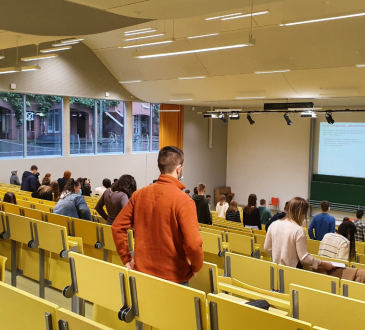
Three workshops will take place on Thursday, January 29, 2026, Tuesday, February 24, 2026, and Wednesday, March 25, 2026, at 12:30 p.m., both over Zoom and in person in the Slowinski Courtroom at the Catholic University of America, Columbus School of Law.
The three workshops will provide students and faculty with the opportunity to discuss a wide range of interdisciplinary issues related to current challenges to international law, including the conflicts in Ukraine and Gaza, as well as American military intervention in Venezuela.The workshops precede a two-day international conference, International Criminal Law 80 Years Later: The Crossroads of Law, Ethics, Religion, and International Law, to be held at The Catholic University of America on April 12 and 13, 2027.
Reflections: What is the continuing legacy of the Nuremberg Principles in a collapsing and transitioning world order?
Wednesday, March 25, 2026 at 12:30 p.m.
The Catholic University of America Columbus School of Law • Walter A. Slowinski Courtroom
Registration by the link
The third seminar. Around 1930, Italian communist Antonio Gramsci, imprisoned by the fascist dictator Mussolini, wrote in his Prison Notebooks that “the old world is dying and the new world struggles to be born: now is the time of monsters.” Gramsci saw a dangerous vacuum as the old political order was collapsing, but a new one had not yet emerged. This interregnum created the opportunity for monsters to arise and gain power.
Nearly 100 years after Gramsci, there are signs of a similar period of instability in the international world order. We are witnessing a legitimacy crisis for the vision set out in the Nuremberg Principles: the assumption that the global community would work together to promote principles of cooperation, humanity, and peace. The United States, which played a central role in creating this “new world order” after World War II ended in 1945, now appears to be turning its back on it, viewing it as outdated and counterproductive to American national interests. Other powerful states, including Russia and China, are actively challenging the “new world order,” engaging in overt aggression, refusing to cooperate with international criminal tribunals, and criticizing the rules-based order and Western democratic values as illegitimate and arbitrary. Challenges to the “new world order” are not limited to powerful states; many others, such as Canada, see the postwar US-led international order as fundamentally broken and advocate that “middle powers” build new partnerships to protect their interests.
More information about the series of online seminars can be found by following the link.