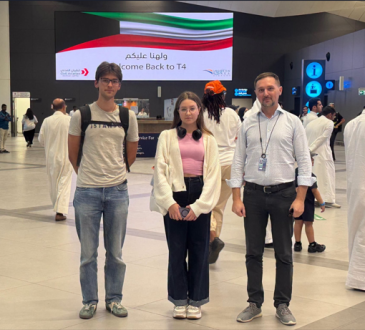
Elyzaveta Khmarska, the 4th-year student of the educational program “Japanese Language and Literature and Translation, English Language” of the Educational and Scientific Institute of Philology, studied under the exchange program at Aoyama Gakuin University (Japan) during the fall semester of the 2025-2026 academic year. She has now returned to Taras Shevchenko National University of Kyiv and is studying diligently, preparing for exams and the graduation.
Elyzaveta Khmarska came to Tokyo with a love of world literature. While studying Japanese at Taras Shevchenko National University of Kyiv, she immersed herself in the works of Japanese authors, looking for universal themes in Japanese stories. At Aoyama Gakuin University, she lives among what she had only imagined through stories – discovering for herself how literature serves as both a window and a bridge between cultures.
Elyzaveta Khmarska notes: «My relationship with Japanese culture began, like many, with anime flickering across a television screen in my childhood. But it was literature that truly captured my imagination and set me on the path that would eventually lead me to Tokyo. As a teenager, I stumbled upon films like Rashomon and Tokyo Story—old, black and white, with long stretches of silence that felt alien by modern standards. Yet something about those films stayed with me. I could recall specific scenes, the emotions they stirred, years after watching them.
What draws me to Japanese literature is how authors engage with the world around them. Take Natsume Sōseki’s Kokoro, for example. The novel is deeply connected to the Meiji era and the collision of Western values with traditional Japanese values. The protagonist struggles with change in a rapidly transforming society—a feeling that resonates universally, especially in times like ours. Yet the novel also contains elements that are uniquely Japanese, reflecting a specific historical moment that other literatures simply lack.
Through my studies, I’ve come to see literature as more than entertainment or art. It’s a lens for understanding how different cultures process similar human experiences. Even authors whose perspectives I disagree with have taught me something valuable, helping me recognize parallels between societal concerns in Japan and Ukraine across the decades, or revealing assumptions in my own worldview I hadn’t questioned before. »
Elyzaveta Khmarska shares her experience: «Living in Japan has given me the chance to see how my own knowledge and experiences fit into a larger picture. Growing up in Ukraine, forming my own national identity, and gaining an understanding of my own country’s history and struggles has been deeply formative, and being here has not changed any of that. What it has done is open doors to perspectives that I simply couldn’t access from home. »
Elyzaveta Khmarska underlines: «While I plan to spend my professional life in Ukraine because I feel a deep connection to my own culture, I would love to return to Japan in a few years to work here and deepen my understanding. Right now, I know there are many things beyond my reach simply because I’m not fully fluent in Japanese. I’d like to come back when I’m more confident, perhaps to share Ukrainian culture with Japanese people more effectively, or to learn what it truly means to be part of broader Asian society. »
Elyzaveta Khmarska emphasizes: «Coming to Japan has also inspired me to be a better tourist in my own country. Here, I’ve discovered I enjoy traveling alone, seeking out places that reflect Japanese culture. If I can do that here, I can do the same with Ukrainian culture. I’ve already started planning trips to explore Ukraine more thoroughly when I return.
As I reach the halfway point of my exchange and look toward my return home, I carry with me something more valuable than any single fact or skill. I’m learning to hold multiple truths at once. To understand that assumptions that work in one context may not apply in another, that human experiences connect us even as our responses differ, and that real understanding requires not just reading about a culture but living within it—making mistakes, asking questions, and remaining open to having your perspective challenged and expanded.»
Resource: The interview with Elyzaveta Khmarska